
True wellness isn't about following the latest diet trends or achieving the perfect body. It's about how we feel, how we nourish ourselves and how we care for our physical, emotional and spiritual wellbeing.
Over the years, through my own wellness journey, my yoga practice and my exploration of Eastern healing philosophies, I have come to understand that nourishing ourselves goes far beyond what we eat.
We often associate wellness with movement, meditation, yoga and finding moments of stillness. But something we sometimes overlook is the importance of nutrition and the relationship between the food we eat, our emotional wellbeing and our energy.
As someone who practises and teaches Yin Yoga, I have become increasingly interested in the connection between our physical bodies, our emotions and the ancient wisdom of Traditional Chinese Medicine, Taoism and Ayurveda.
And one thing that continues to resonate with me is this:
We cannot expect to feel balanced, grounded and at peace if we are constantly neglecting the very thing that sustains us and that is nourishment.
But before exploring the relationship between nutrition, Yin Yoga and these ancient philosophies, I want to address something that I feel is particularly important.
Nutrition Is About So Much More Than Achieving The Perfect Body
I think one of the biggest misconceptions about nutrition and healthy living is that it is somehow connected to chasing the body perfect, losing weight or following the latest diet trend.
We live in a world where we are constantly being told what to eat, what not to eat, which foods are supposedly good or bad and what our bodies should look like.
One minute we're encouraged to eliminate carbohydrates, the next we're told to follow a particular diet, count calories or chase the latest wellness trend.
And somewhere along the way, I think we've lost sight of what nutrition is really about.
For me, nutrition isn't about striving for the perfect body. It's about creating a healthy, nourished body that allows us to feel our best.
It's about waking up in the morning with energy.
It's about supporting our immune system, our digestion, our physical health and our emotional wellbeing.
It's about feeling comfortable within ourselves, having a healthy relationship with food and giving our bodies the nutrients they need to function and thrive.
And perhaps most importantly, it's about learning to nourish ourselves without guilt, restriction or constantly comparing ourselves to others.
Being thin doesn't automatically mean someone is healthy, just as someone's body size doesn't tell us everything about their wellbeing.
I believe we need to move away from the idea that wellness is something we can measure simply by looking in the mirror or stepping onto a set of scales.
True wellness is about how we feel, not just how we look.
And this is where I see such a beautiful connection with Yin Yoga.
Yin doesn't ask us to compete, perform or make our bodies look a certain way.
It asks us to listen.
To become aware of what we need.
To respect our bodies rather than constantly trying to change them.
And I believe nutrition should be approached with that same philosophy.
Eating well shouldn't feel like punishment. It should be an act of kindness towards ourselves.
We don't need another restrictive diet or another trend telling us how we should look.
We need to reconnect with our bodies, understand what truly nourishes us and recognise that being healthy is about so much more than a number on the scales.
Because the goal is to be healthy, nourished, energised and at peace within ourselves.
And that, to me, is what true wellness is all about.
Yin Yoga: Nourishing More Than the Physical Body
Yin Yoga is so much more than stretching or holding poses for several minutes.
For me, Yin is about slowing down, turning inward and creating space to listen to what our bodies are trying to tell us.
Rooted in principles influenced by Taoist philosophy and Traditional Chinese Medicine, Yin Yoga encourages us to explore the relationship between our physical body, our energy and our emotional wellbeing.
In Traditional Chinese Medicine, the body is understood through a network of meridians, or energetic pathways, associated with different organ systems.
Within this traditional framework, these pathways are believed to influence the movement of Qi, our vital life energy.
In Yin Yoga, we work with postures traditionally associated with these meridian pathways, creating opportunities for stillness, awareness and energetic balance.
Although meridians and Qi are traditional concepts rather than scientifically established anatomical structures, I find they offer a meaningful way to reflect on our connection with ourselves and the natural world.
But something I find particularly fascinating is that Traditional Chinese Medicine doesn't view food simply as calories, protein, carbohydrates or vitamins.
Food is also understood through its energetic qualities and its relationship with the seasons, the organs and the Five Elements.
And this is where nutrition and Yin Yoga begin to connect so beautifully.
Eating with the Seasons: The Taoist Five Elements
In Taoist philosophy and Traditional Chinese Medicine, the Five Elements — Wood, Fire, Earth, Metal and Water, represent different qualities and cycles within nature.
Each element is traditionally associated with particular seasons, organs, emotions, flavours and foods.
The philosophy encourages us to recognise that we are not separate from nature.
Just as the seasons change, our bodies and our needs change too.
And I find something incredibly grounding about that.
We don't expect nature to remain the same throughout the year, so why do we place so much pressure on ourselves to constantly feel, perform and function in exactly the same way?
Wood Element — Spring: Renewal and Growth
Spring represents new beginnings, movement and renewal.
The Wood Element is associated with the Liver and Gallbladder meridians, and with the emotion of anger when energy feels stagnant or out of balance.
In Traditional Chinese Medicine, sour flavours are associated with the Wood Element.
Fresh greens, leafy vegetables, herbs and lightly cooked seasonal foods are often emphasised in spring-inspired eating.
Within Yin Yoga, we might explore poses such as Dragon, Butterfly or Shoelace, which are traditionally associated with the Liver and Gallbladder meridian pathways.
For me, spring is a reminder to release what has become stagnant, physically and emotionally, and make space for something new.
Just as nature begins to blossom again, perhaps we can allow ourselves to grow, change and begin again too.
Fire Element — Summer: Joy and Connection
Summer represents warmth, expansion, connection and joy.
The Fire Element is associated with the Heart and Small Intestine, as well as the Pericardium and Triple Burner meridian systems.
Its associated flavour is bitter.
Seasonal vegetables, leafy greens and naturally hydrating foods can form part of a nourishing summer diet.
In Yin Yoga, Heart-opening postures such as Melting Heart and supported chest openers can encourage us to soften, release tension and reconnect with ourselves.
The Fire Element reminds me that nourishment is not only about food.
It is also about joy, laughter, love, connection and allowing ourselves to experience the beauty of life.
Because we can eat all the healthy food in the world, but if we never allow ourselves to experience joy, connection or happiness, something important is still missing.
Earth Element — Late Summer: Grounding and Nourishment
The Earth Element is particularly meaningful when we explore the relationship between nutrition and wellbeing.
Associated with the Spleen and Stomach meridians, Earth represents nourishment, stability and our ability to receive and process what life gives us.
Its associated flavour is sweet, not necessarily refined sugar, but the natural sweetness found in foods such as pumpkin, sweet potatoes, carrots and grains.
Traditional Chinese dietary principles often favour warm, cooked and easily digestible meals when supporting the Earth Element.
And emotionally, Earth is associated with worry and overthinking.
I find this connection especially interesting because when life becomes overwhelming, our eating habits can be among the first things to suffer.
We rush meals. We skip them. We eat without really paying attention.
Sometimes we are so busy nourishing everyone else that we forget to nourish ourselves.
And I think many of us can relate to that.
We give our time, our energy and our care to the people around us, but how often do we stop and ask whether we are giving ourselves that same attention?
In Yin Yoga, gentle poses such as supported Saddle or other appropriate front-body stretches may be used when exploring the Stomach and Spleen meridian pathways.
The Earth Element teaches us something beautiful:
Nourishment is an act of self-care. And we deserve to receive the same care that we so freely give to others.
Metal Element — Autumn: Letting Go
Autumn is a season of transition, reflection and release.
The Metal Element is associated with the Lung and Large Intestine meridians, and traditionally with grief and sadness.
Its associated flavour is pungent.
Foods such as ginger, garlic, radishes and warming soups are often incorporated into autumn-inspired eating.
In Yin Yoga, we may explore gentle chest and shoulder openers, supported Fish or other postures associated with the Lung and Large Intestine pathways.
Autumn reminds us that letting go is part of life.
Just as trees release their leaves, we too can learn to release emotions, experiences and attachments that no longer serve us.
And perhaps nourishment during these periods means choosing warmth, comfort and gentleness rather than constantly pushing ourselves to do more.
Sometimes taking care of ourselves means recognising what we need to release, rather than what else we need to achieve.
Water Element — Winter: Rest and Restoration
Winter is the season most closely associated with Yin energy.
It represents stillness, reflection, conservation and rest.
The Water Element is associated with the Kidney and Urinary Bladder meridians and traditionally with the emotion of fear.
Its associated flavour is salty.
Warming soups, stews, beans, root vegetables and nourishing broths are often included in winter-focused Chinese dietary traditions.
In Yin Yoga, poses such as Caterpillar, Butterfly and gentle forward folds are commonly associated with the Kidney and Bladder meridian pathways.
Winter reminds us that we are not designed to be constantly productive.
Nature rests. The earth becomes quiet. Energy is conserved.
And perhaps we should give ourselves permission to do the same.
Sometimes the most nourishing thing we can do is simply rest.
Ayurveda: Eating According to Our Individual Nature
My exploration of Ayurveda has also helped me appreciate that nutrition is not necessarily a one-size-fits-all approach.
Ayurveda, the ancient Indian system of traditional medicine, approaches wellbeing through the relationship between body, mind, lifestyle and environment.
At the heart of Ayurveda are three doshas: Vata, Pitta and Kapha.
These are traditional constitutional principles used to describe different patterns and qualities within the body and mind.
Vata, associated with air and space, represents movement, lightness and change.
Traditional Ayurvedic dietary guidance often favours warm, grounding and nourishing meals when Vata qualities are considered excessive.
Pitta, associated with fire and water, represents heat, transformation and digestion.
Cooling, less intensely spiced foods are often recommended within Ayurvedic traditions when Pitta is considered elevated.
Kapha, associated with earth and water, represents stability, structure and heaviness.
Lighter, warming and stimulating foods are traditionally encouraged when Kapha qualities are considered excessive.
What I appreciate about Ayurveda is its emphasis on observing ourselves rather than blindly following trends.
It encourages us to consider how we feel, how we digest our food, how the seasons affect us and how our daily routines influence our wellbeing.
It also introduces the concept of Agni, often described as digestive fire.
Within Ayurvedic philosophy, digestion is considered central to wellbeing, and mindful eating is an important part of supporting it.
Although Ayurveda and Traditional Chinese Medicine are distinct systems with different histories and explanations, I find they share a beautiful underlying message.
Listen to your body. Respect the seasons. Nourish yourself with intention.
These traditional frameworks can offer meaningful inspiration, although their specific claims about doshas, meridians and food energetics are not all supported by modern scientific evidence. I believe we can appreciate their wisdom while also recognising the importance of evidence-based nutrition and individual health needs.
And for me, this is what makes these philosophies so interesting.
They encourage us to become more aware of ourselves rather than constantly searching for the next trend or quick fix.
The Relationship Between Food and Our Emotions
Something I have become increasingly aware of is how closely our eating habits can be connected to our emotional state.
When we are stressed, anxious or overwhelmed, we might lose our appetite, crave comfort foods or eat without really noticing what we are consuming.
And when our bodies are not receiving adequate nourishment, it can become harder to manage our energy, concentration and emotional wellbeing.
Nutrition and mental wellbeing are connected through complex biological and behavioural processes.
But beyond the science, there is something deeply personal about how we nourish ourselves.
I have had periods when my mind has been so busy, with so many things going on, that I have found it difficult to fully settle into my own wellness practices.
And it has reminded me that practising wellness isn't simply about stepping onto a yoga mat.
It's about the choices we make throughout the day.
It's about recognising when we are exhausted, when we need proper nourishment, when we need to slow down and when our bodies are asking for a little more care.
We can spend an hour practising Yin Yoga, but if we spend the rest of the day rushing, neglecting our meals and ignoring our needs, we may be missing an important part of the practice.
And this is why I believe that healthy eating should never be about restriction or punishment.
Food should be something that supports us, nourishes us and allows us to enjoy life.
There is nothing wrong with enjoying a piece of cake, sharing a beautiful meal with friends or eating something simply because it brings us pleasure.
Balance isn't about perfection.
It's about creating a way of living that supports our health without taking away the joy of being alive.
True wellness is not something we practise for an hour. It is something we learn to bring into our everyday lives.
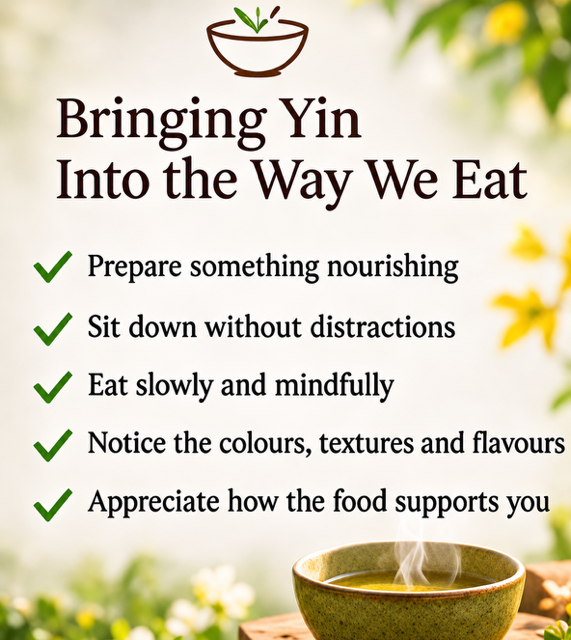
Bringing Yin Into the Way We Eat
One of the most beautiful lessons Yin Yoga has taught me is the importance of presence.
In Yin, we don't rush to the next pose.
We settle. We breathe. We observe.
And I believe we can bring this same philosophy into the way we eat.
How often do we eat while scrolling through our phones, answering emails, watching television or thinking about everything we still need to do?
We consume our food, but are we really experiencing it?
What if we approached our meals with the same awareness that we bring to our Yin practice?
Taking time to prepare something nourishing.
Sitting down without distractions.
Noticing the colours, textures and flavours.
Eating slowly enough to recognise when we are satisfied.
And perhaps, most importantly, appreciating that the food in front of us is helping to sustain our bodies.
This doesn't mean every meal needs to become a spiritual ritual.
Life is busy, and sometimes we simply need to eat whatever is practical and available.
But even small moments of mindfulness can begin to change our relationship with food.
We can also honour the nutritional foundations our bodies need — adequate protein, fibre, healthy fats, vitamins, minerals and sufficient energy — while drawing inspiration from seasonal and traditional approaches to eating.
There is room for both ancient wisdom and modern nutritional science.
And I think that is where a truly balanced approach to wellness begins.
Not by following rigid rules, but by becoming more aware of what supports our wellbeing.
Nourishment Is Also About What We Allow Into Our Lives
The more I explore wellness, the more I realise that nourishment goes beyond the food on our plates.
We are also nourished, or depleted, by our environments, relationships, thoughts and daily experiences.
We can eat the healthiest meals, practise yoga every day and follow every wellness routine imaginable.
But if we are constantly surrounded by stress, conflict, negativity or situations that drain us emotionally, something will still feel out of balance.
This is something I have come to understand more deeply through my own life experiences.
For a long time, I believed that being healthy meant doing all the right things.
Practising yoga. Meditating. Eating well. Staying active.
And while all of those things are important, I have come to realise that our emotional wellbeing deserves just as much attention as our physical health.
What is the point of nourishing our bodies if we are constantly allowing our peace to be disturbed?
What is the point of practising mindfulness if we never give ourselves permission to slow down?
And what is the point of looking after everyone else if we are continually neglecting ourselves?
This is why I believe Yin Yoga, nutrition and mindful living belong together.
Yin teaches us to pause.
Nutrition supports our physical wellbeing.
Traditional philosophies encourage us to observe our relationship with nature and the changing seasons.
And mindfulness helps us recognise what we truly need.
Sometimes nourishment means preparing a beautiful, wholesome meal.
Sometimes it means practising Yin Yoga for an hour.
Sometimes it means going for a walk in nature, switching off your phone, setting a boundary or simply allowing yourself to rest without feeling guilty.
Not everything that nourishes us comes from food. And not everything that drains us comes from physical exhaustion.
A Gentle Reminder to Nourish Yourself
If there is one thing I hope you take away from this, it is that wellness doesn't have to be complicated.
You don't need to be skinny to be healthy.
You don't need to follow the latest diet trend.
You don't need to eliminate entire food groups, obsess over calories or constantly strive to change the way your body looks.
And you certainly don't need to get everything right.
For me, the beauty of Yin Yoga, Ayurveda and Taoist philosophy lies in their invitation to become more aware of ourselves.
To understand that we are constantly changing.
That what nourished us yesterday might not be what we need today.
That there are seasons for growth and seasons for rest.
And that caring for ourselves is not selfish. It is essential.
As I continue my own journey, I am learning that balance is not about controlling every aspect of my life.
It is about listening more closely, being kinder to myself and making choices that support my physical, emotional and spiritual wellbeing.
It's about eating foods that help me feel healthy and energised, while also enjoying life without guilt.
It's about understanding that my body deserves kindness and respect, regardless of its shape or size.
And it's about remembering that health isn't simply about what we see on the outside. It's about how we feel on the inside.
So whether you are stepping onto your Yoga mat, preparing your next meal or simply taking a quiet moment for yourself, I encourage you to ask:
What do I truly need today?
Not what the world expects of you.
Not what the latest wellness trend tells you.
Not what everyone else is doing.
But what your own body, mind and heart are asking for.
Because ultimately, nourishing yourself is one of the most beautiful forms of self-love.
And if sharing my experiences, the philosophies I explore and the lessons I continue to learn encourages even one person to slow down, listen to themselves and take better care of their wellbeing, then that makes sharing this journey worthwhile.
Remember, your body is your home.
Nourish it. Respect it. Listen to it.
Not because you need to change how it looks, but because you deserve to feel healthy, balanced and at peace within yourself.
With so much love, light and gratitude.
Serina Sunshine xxx