
Grief is not something we simply get over. It is something we learn to move with, breathe through, and eventually make space for within our hearts.
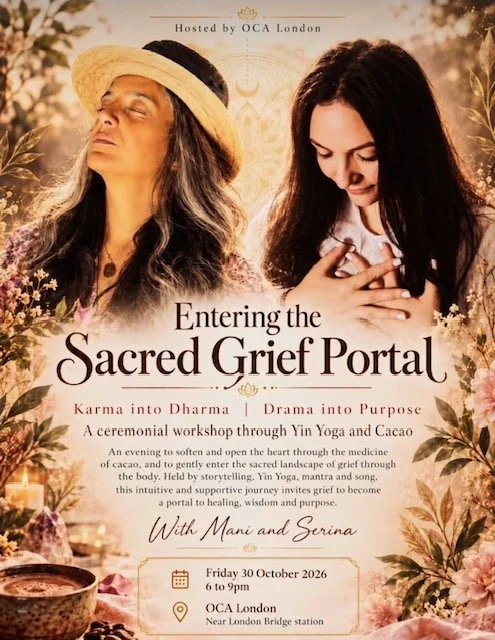
On Friday night, I had the honour of holding a beautiful Sacred Grief Portal in collaboration with the wonderful Mani. Together, we created a safe and nurturing space for some truly lovely souls to come together, to soften, to surrender and, perhaps most importantly, to simply be.
Through the gentle practices of Yin Yoga, energy cleansing, healing, sound and the nurturing power of touch, we invited people to explore their grief without judgement, expectation or the pressure to be anything other than themselves.
There was something incredibly moving about witnessing people give themselves permission to pause, to feel and to acknowledge emotions that perhaps had been sitting quietly beneath the surface for a very long time.
It reminded me of something I have come to understand through my own journey:
Grief does not always need fixing. Sometimes it simply needs somewhere safe to land.
And it got me thinking about how we experience grief, how we carry it and why creating spaces for emotional healing feels more important today than ever before.
When we think about grief, we often associate it with death and the loss of someone we love. But grief is so much more expansive than that.
We can grieve relationships that have ended, friendships that have faded, homes we have left behind, dreams that never unfolded, or versions of ourselves we no longer recognise.
We can grieve the childhood we wished we had, the love we never received, the opportunities we missed, or the life we thought we would be living.
Sometimes grief arrives suddenly and completely changes our world. Other times it develops quietly, accumulating through years of disappointment, change, uncertainty and unspoken emotions.
And sometimes we don't even realise that what we are carrying is grief.
We simply know that something within us feels heavy.
We feel disconnected, exhausted, restless or emotionally overwhelmed. We keep ourselves busy, fill our days with distractions and convince ourselves that we are fine.
Because somewhere along the way, many of us have learned that being strong means holding everything together.
But what if true strength is allowing ourselves to fall apart occasionally?
What if healing begins when we stop running from what hurts?
My Own Journey Through Grief
Grief has been one of my greatest teachers, although I certainly wouldn't have described it that way when I was in the middle of experiencing it.
When I was going through my own grief, there were times when I didn't know what to do with the emotions I was carrying.
There were moments of sadness, confusion, anger and a deep sense of loss. There were times when I wanted answers, when I wanted things to make sense and when I simply wanted the heaviness to disappear.
Like so many of us, I initially believed that healing meant finding a way to move forward, to be strong and to somehow return to the person I had been before.
But grief changes us.
And I eventually began to understand that I didn't need to become the person I was before. I needed to learn how to be with the person I was becoming.
One of the most important things I learned was how to sit with my grief rather than constantly trying to escape it.
To allow myself to cry when I needed to cry. To acknowledge the anger, the sadness and the uncertainty without judging myself for feeling them.
To recognise that some days I would feel peaceful and hopeful, while other days a memory, a song or even a familiar smell could bring everything rushing back.
And that was okay.
I learned that healing wasn't about forgetting, suppressing or pretending something hadn't happened.
It was about learning to live alongside my experiences without allowing the pain to define every part of my life.
Over time, I began to see that grief and gratitude could exist together. That I could miss what I had lost while still feeling excited about what life might bring.
And perhaps most importantly, I learned that I could make room for joy again without betraying the love or memories of what I had lost.
That understanding changed something within me, I learnt that the body holds what the heart cannot express.
Our minds are incredibly good at finding ways to keep us functioning, particularly when life feels overwhelming.
We push emotions aside, distract ourselves with work, responsibilities and endless to-do lists, and tell ourselves we will deal with everything later.
But our emotional experiences are not separate from our physical wellbeing.
Grief can affect our nervous system, our breathing, our sleep, our energy levels and the way we experience our bodies.
We may notice tension in our shoulders, tightness around the chest, a heavy feeling in the stomach or an inability to truly relax.
Sometimes, even when our minds believe we have moved on, our bodies continue to respond to reminders of what we have experienced.
This is often described in holistic healing traditions as grief being stored in the body.
Although emotions are not literally stored in individual muscles or organs in the way we might store an object, our bodies can carry patterns of tension, protective responses and stress associated with difficult emotional experiences.
And this is where gentle, body-based practices can be incredibly supportive.
Rather than always trying to think our way through grief, we can begin to listen to what our bodies are communicating.
We can create opportunities to soften, breathe and reconnect with ourselves.
Yin Yoga and Opening The Door To Emotional Healing
One of the reasons I find Yin Yoga so beautiful is that it invites us to do something that modern life rarely encourages.
To slow down. To become still. To stop doing and simply feel.
Unlike more dynamic styles of yoga, Yin Yoga involves holding gentle, supported postures for longer periods, often between three and five minutes.
These longer holds allow us to explore stillness, cultivate patience and become more aware of physical sensations and emotions as they arise.
In Traditional Chinese Medicine, which influences many modern Yin Yoga practices, grief is associated with the lungs and large intestine meridians.
The lungs symbolically connect us with receiving life through the breath, while the large intestine is associated with the process of releasing what we no longer need.
I find this symbolism particularly beautiful when exploring grief.
Because so much of our emotional journey involves learning when to hold on and when to let go.
In Yin Yoga, postures that gently open the chest, shoulders and upper body can create a sense of spaciousness around the breath.
Supported heart-opening poses, gentle twists and restorative forward folds can encourage us to turn inward, notice our feelings and soften areas where we may be holding tension.
These meridian associations are part of a traditional healing framework rather than scientifically established pathways for releasing particular emotions. Yet the practice itself can offer a meaningful space for reflection and nervous-system regulation.
And sometimes, when we finally become still, emotions we have been avoiding begin to surface.
Perhaps tears arrive unexpectedly.
Perhaps we feel sadness, tenderness or even relief.
Or perhaps nothing dramatic happens at all, and we simply experience a moment of peace.
There is no right or wrong response.
Yin Yoga is not about forcing an emotional release. It is about creating enough safety and space for whatever needs our attention to be acknowledged.
For me, this is where its true beauty lies.
It teaches us to remain present with ourselves, even when what we are feeling is uncomfortable.
And perhaps that is one of the most valuable lessons grief can offer us.
The Healing Language of Sound, Energy and Touch
During Friday night's Sacred Grief Portal, we brought together different healing practices to support this journey inward.
Sound healing can be a particularly beautiful companion to grief work.
The gentle resonance of singing bowls and other instruments creates an immersive experience that can encourage relaxation, quieten mental chatter and invite us to become more present.
There is something deeply comforting about allowing sound to surround you when words feel inadequate.
Sometimes grief is simply too complex to explain.
Sometimes we don't know what we are feeling, let alone how to communicate it.
And in those moments, music, vibration and silence can offer a different way of connecting with ourselves.
Energy cleansing and healing rituals can also provide meaningful opportunities to reflect on what we are carrying and what we feel ready to release.
Whether experienced spiritually or symbolically, these practices can help us set intentions and mark moments of personal transition.
And then there is the power of touch.
Gentle, respectful and consent-based touch can be profoundly reassuring.
A hand resting softly on a shoulder, a nurturing adjustment or simply the presence of another person can remind us that we do not have to carry everything alone.
Of course, healing looks different for everyone. Not everyone wants to be touched and not everyone connects with sound or energy practices in the same way.
But what matters is the intention behind creating these spaces.
An invitation to feel supported.
An invitation to reconnect.
An invitation to remember that we are human, and that being human means experiencing both love and loss.
I think one of the greatest misunderstandings about grief is that we are supposed to eventually reach a point where it no longer affects us.
We hear phrases such as "time heals everything", "you need to move on" or "you have to stay strong".
Often these words come from people who genuinely care but simply don't know how to sit alongside another person's pain.
Yet grief doesn't follow a timetable.
It isn't linear and it doesn't always become smaller in the way we expect.
Some losses will always hold a place within us.
And I don't believe healing necessarily means removing that place.
I believe it means learning how to carry our experiences with greater compassion, so that grief no longer takes away our ability to fully experience life.
When we constantly suppress our feelings, we may find ourselves becoming disconnected from our needs, our relationships and our sense of self.
But when we give ourselves permission to acknowledge grief, whether through movement, conversation, creativity, therapy, meditation or simply allowing ourselves to cry, we begin to develop a healthier relationship with what we have experienced.
Letting go does not mean forgetting.
It doesn't mean that what happened was acceptable, that the loss no longer matters, or that we must stop missing someone.
Sometimes letting go simply means releasing the pressure to be okay all the time.
Releasing the guilt of finding happiness again.
Releasing the belief that we should have healed by now.
And allowing ourselves to move forward while still honouring everything that has shaped us.
A World The Needs More Compassion, Connection and Space to be Heard
I look at the world today and often wonder when we became so disconnected from the simple act of listening to one another.
We live in a society that celebrates productivity, achievement, independence and constantly moving forward.
We are encouraged to be resilient, to keep going and to present the best versions of ourselves, even when internally we may be struggling.
Social media shows us carefully curated moments of happiness and success, while so much of the real human experience remains hidden.
The loneliness.
The heartbreak.
The uncertainty.
The quiet grief that people carry behind their smiles.
And with so much conflict, suffering, division and uncertainty in the world, I believe we need compassionate spaces more than ever.
Spaces where people don't have to explain themselves.
Where vulnerability isn't mistaken for weakness.
Where tears are welcomed rather than quickly wiped away.
Where someone can say, "I'm not okay," and feel genuinely heard.
We don't always need someone to offer advice or tell us how to fix our lives.
Sometimes we just need another human being to sit beside us and acknowledge what we are going through.
To be witnessed in our grief is to be reminded that we are not alone.
This is one of the reasons I feel so drawn to creating and sharing these experiences.
Because healing isn't always something we have to navigate in isolation.
There is something incredibly powerful about coming together in community, even with people we may have only just met, and recognising our shared humanity.
Different stories. Different losses. Different journeys.
But a common understanding that we all experience pain and we all deserve compassion.
Looking back on my own journey with grief, I often wish I had been surrounded by the kind of love, understanding and support that we created in our Sacred Grief Portal. Instead, I found myself navigating much of that pain alone, trying to make sense of emotions I didn't always understand. It was an incredibly lonely and difficult time, but it also became one of my greatest teachers. Through that experience, I learned the importance of sitting with my emotions, finding strength in vulnerability and slowly learning to heal. Perhaps that is why holding space for others means so much to me today, because I know how deeply I would have appreciated someone simply being there, listening without judgement and reminding me that I didn't have to carry it all alone.
If grief has taught me anything, it is that life is constantly changing.
People come into our lives and sometimes leave them.
Relationships evolve.
Dreams change.
We outgrow places, identities and versions of ourselves.
And while these transitions can be incredibly painful, they can also invite us to look more deeply at what truly matters.
My own experiences have encouraged me to become more compassionate, more present and more intentional about the life I want to create.
I have learned to appreciate quieter moments, meaningful connections, the beauty of nature and the simple feeling of being at peace within myself.
Not because grief magically made everything better, but because moving through difficult experiences encouraged me to reconsider what I valued.
I no longer believe that a meaningful life is one without sadness.
I believe it is a life where we allow ourselves to experience the full spectrum of being human.
To love deeply, knowing that love can sometimes bring loss.
To embrace change, even when it feels frightening.
To find joy without feeling guilty.
And to recognise that even after some of our darkest chapters, there can still be beauty waiting to unfold.
A Gentle Invitation to Yourself
As I reflect on Friday night's Sacred Grief Portal, I feel incredibly grateful to Mani and to everyone who trusted us enough to share that space.
It was a reminder of how much courage it can take to slow down and turn towards the parts of ourselves we have spent so long trying to protect.
And how beautiful it can be when we give one another permission to simply be human.
If you are navigating grief right now, in whatever form it may be taking, I hope you can offer yourself a little more gentleness.
You do not have to rush your healing.
You do not have to make sense of everything.
You do not have to transform your pain into something positive before you are ready.
Find the practices, people and places that help you feel safe and supported. Allow yourself to rest. Speak about what hurts when you can. Seek professional support when you need it.
And remember that healing is not measured by how rarely you cry or how quickly you move forward.
Sometimes healing is simply waking up and choosing to meet yourself with a little more kindness than you did yesterday.
Grief is the reflection of something that mattered. Something we loved, something we hoped for, or something that was once part of who we were.
We don't have to erase it to find peace.
We can learn to make space for it, to honour it and, in our own time, to open our hearts to life again.
Because perhaps the greatest gift we can give ourselves is not the ability to avoid pain, but the courage to remain open to love, connection and all the beautiful possibilities that still lie ahead.
With love, compassion and gratitude.
May we continue creating spaces where hearts can soften, stories can be heard and no one has to carry their grief alone.
So much love and peace to you all.
Serina Sunshine xx