Yin Isn’t Just the Postures — It’s a Way of Life
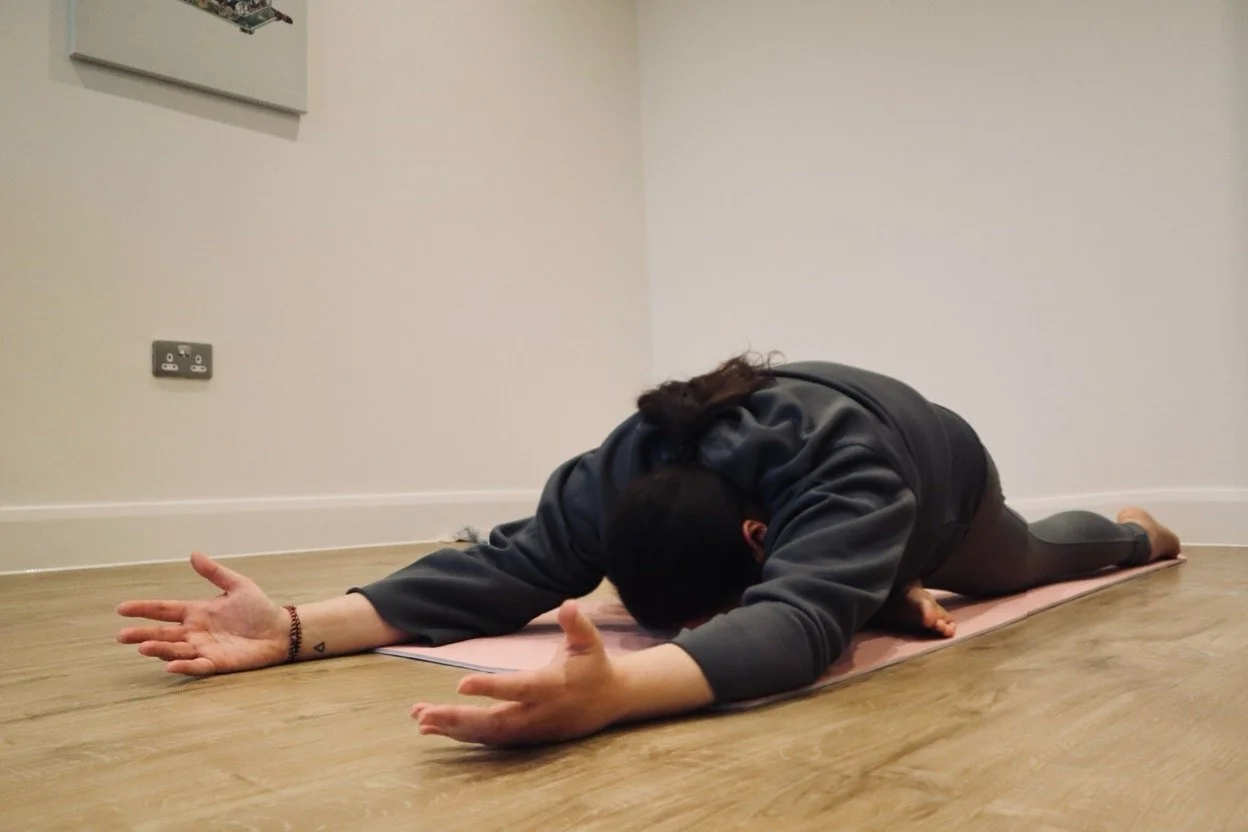
Sleeping Swan
“Serina… why do you never post any Yin poses?”
It’s a question I get asked from time to time, and I understand the curiosity. Yoga, especially online, is so often presented through images of bodies in shapes. Beautiful shapes. Impressive shapes. Aspirational shapes.
But the truth is simple:
Yin isn’t just the postures… It’s a way of living.
Yin is a way of softening in a world that constantly asks you to harden.
A way of listening when everything around you is loud.
A way of staying with yourself instead of being pulled endlessly outward.
Yes, Yin has shapes and they can be beautiful.
But how a pose looks is the least important part of the practice.
From a Yin perspective, the body is not something to sculpt, it is something to sense.
Yin Yoga works primarily with the deeper connective tissues of the body, fascia, ligaments, joints, rather than the large, superficial muscles we engage in more dynamic styles of yoga. These tissues respond not to force, but to time, patience, and gentle stress.
This is why stillness matters.
This is why effort softens instead of increases.
And this is also why every body will look different in a pose:
Different bones.
Different joint structures.
Different fascial patterns.
Different nervous systems.
Different histories.
Different emotions.
Different seasons of life.
Two people can be in the “same” pose and have entirely different internal experiences.
From both a scientific and philosophical standpoint, there is no such thing as a universal “correct” Yin shape. Skeletal variation alone makes that impossible. Add lived experience, trauma, stress, age, hormones, emotional state and comparison simply collapses.
There is no “right shape” to photograph.
There is only the right shape for your body, in this moment.
At its roots, Yin Yoga is deeply influenced by Taoist philosophy.
Taoism teaches us about balance — yin and yang — not as opposites, but as complementary forces. Yin is the quiet, the receptive, the internal, the unseen. It is the winter beneath the summer, the stillness beneath movement.
In modern life, we live overwhelmingly in yang, doing, achieving, pushing, producing, fixing.
Yin invites us back into balance.
On a nervous system level, Yin supports the shift from sympathetic activation (fight, flight, freeze) into the parasympathetic state, rest, digest, repair. Long-held, supported postures combined with breath awareness signal safety to the body. And when the body feels safe, it can finally let go.
This is where the real practice begins.
Because Yin isn’t just stretching tissues:
it’s meeting sensations without immediately reacting.
It’s staying present when discomfort arises.
It’s learning the difference between pain and intensity.
It’s practicing trust.
And this is why, in my classes, Yin is so much more than the physical.
Yin is:
✨ mindfulness
✨ breath
✨ sound
✨ energy work
✨ gentle, respectful touch
✨ emotional release
✨ nervous system regulation
✨ community
✨ safety
✨ warmth and holding
Science tells us the body stores experience and philosophy reminds us that awareness is what creates change. Yin sits right at the meeting point of both.
This is the part you can’t capture in a picture.
The real magic of Yin isn’t what the pose looks like, it’s what it feels like when you finally allow yourself to arrive.
It’s the exhale you didn’t know you were holding. The softening of tissues, yes, but also of beliefs. The quiet realisation that you don’t need to push to be worthy of rest.
Maybe one day I’ll share more Yin poses online. But for now, I want this space to be a reminder:
You don’t need to fit yourself into an image, not in yoga, not in your body, not in your life.
Come as you are.
Let the practice meet you.
So much love and light always - Serina Sunshine xx